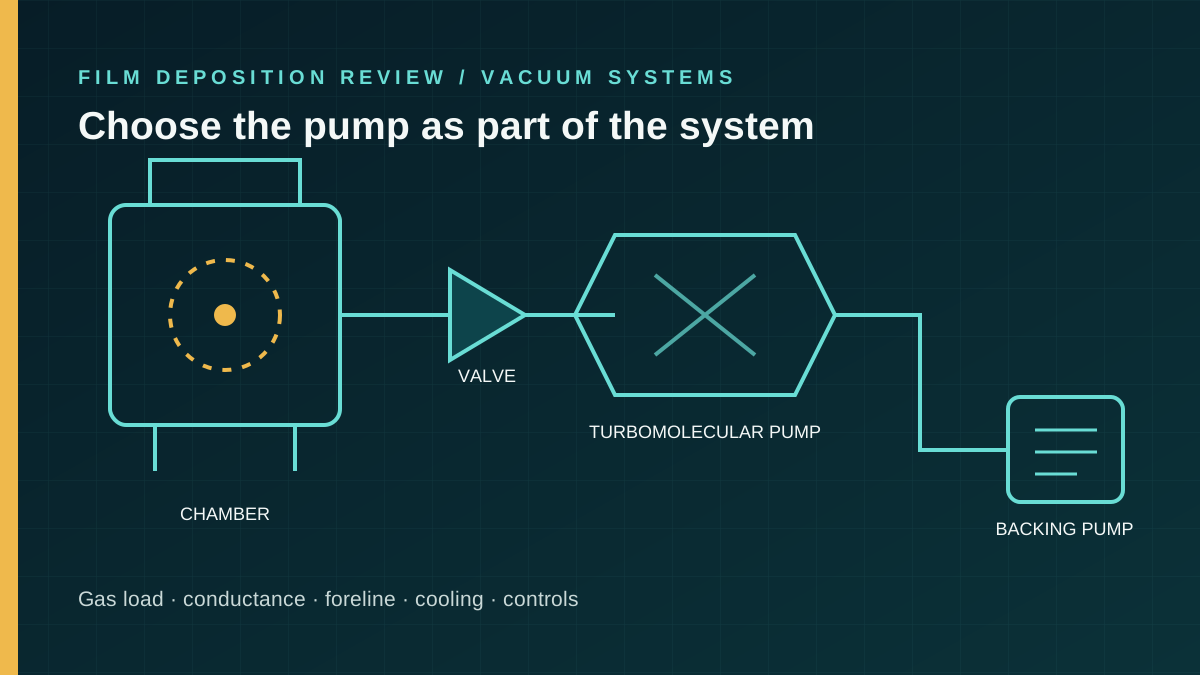
Choosing a turbomolecular pump for a coating chamber is not a matter of buying the largest pumping-speed number in a catalogue. The pump has to work with the chamber, connecting line, backing pump, process gas and operating sequence. A model that looks powerful on its own can deliver disappointing pump-down times if the rest of the system restricts it.
Five questions help expose the parts of the system that a single catalogue number cannot describe.
1. What pressure must be maintained while the process is running?
Base pressure matters, but it is only one operating condition. A deposition chamber may also need to handle argon during sputtering, vapor released from fixtures and substrates, or gas introduced for a reactive process. The useful specification is therefore not simply the lowest pressure reached in an empty test chamber. It is the effective pumping performance at the pressure and gas load used by the real process.
Gas type also matters. Turbomolecular-pump compression ratios vary by gas, with light gases generally behaving differently from heavier molecules. Buyers should identify the expected gas mixture and ask for performance information that is relevant to it.
2. How much of the nominal speed reaches the chamber?
A pump’s rated speed is measured at its inlet under standardized conditions. Between that inlet and the chamber may be a valve, elbow, adapter or length of pipe. Each restriction reduces conductance, so the effective speed at the chamber can be lower than the nameplate value.
This is why the inlet flange and mounting arrangement deserve as much attention as the headline pumping speed. A short, large-diameter connection typically preserves more effective speed than a narrow or convoluted path. Before comparing two models, sketch the complete high-vacuum path and use the conductance of each component to estimate effective speed at the chamber.
3. Is the backing pump matched to both roughing and steady operation?
A turbomolecular pump does not exhaust directly to atmosphere. It relies on a backing pump, which has two jobs: bringing the chamber into a suitable starting range and handling the gas discharged through the turbomolecular pump during operation.
The backing pump should therefore be checked against both the desired roughing time and the expected foreline gas load. An undersized backing pump can prolong cycle time or allow foreline pressure to exceed the turbopump’s stated limit. A larger backing pump is not a universal solution; valve sizing, line conductance and the startup sequence also influence performance. Where contamination control is important, the choice between oil-sealed and dry backing technologies should also be made deliberately.
4. Do cooling, mounting and controls fit the machine?
Integration details often decide whether a pump is practical. Check the permitted installation orientation, required cooling-water conditions or airflow, controller arrangement, communication interface, venting method and available interlocks. The answers affect cabinet layout, utilities, maintenance access and the work needed to connect the pump to the machine control system.
Supplier listings can be read as integration checklists rather than simple rankings. For example, the current listing for the JTFB-700Y turbomolecular pump from JT Vacuum identifies a 700 L/s pumping speed, CF160 or ISO-K160 inlet options, water cooling, grease-lubricated ceramic bearings, multi-angle mounting and an RS-485 interface. Those details do not establish suitability for every deposition system. They are items to verify against the manufacturer’s datasheet and the specific chamber design before ordering.
5. What will the pump encounter between maintenance stops?
Thin-film equipment does not always process clean, inert gas. Condensable material, particles and reactive gases may reach the pumping path. The process owner should discuss purge requirements, inlet protection, venting, cleaning and bearing maintenance before final selection. The appropriate solution depends on the process material and duty cycle; generic claims such as “maintenance-free” should not be accepted without supporting data.
It is also worth defining the acceptable response to power loss, cooling failure and an unexpected pressure rise. Suitable valve logic and controller interlocks can protect both the pump and the chamber.
A short specification checklist
Chamber volume and internal surface condition
Target base pressure and normal process pressure
Process gases and maximum flow
Required pump-down time
Inlet flange, valve and connecting-line dimensions
Backing-pump type and capacity
Cooling, mounting and communication requirements
Contamination risks and expected operating hours
This information clarifies supplier comparisons. It also reduces the chance of selecting a pump that meets an isolated catalogue figure but does not meet the process.
Technical references: Leybold: turbomolecular-pump fundamentals; Leybold: backing-pump selection; Agilent Vacuum Turbo Pumps and Controllers catalogue.

